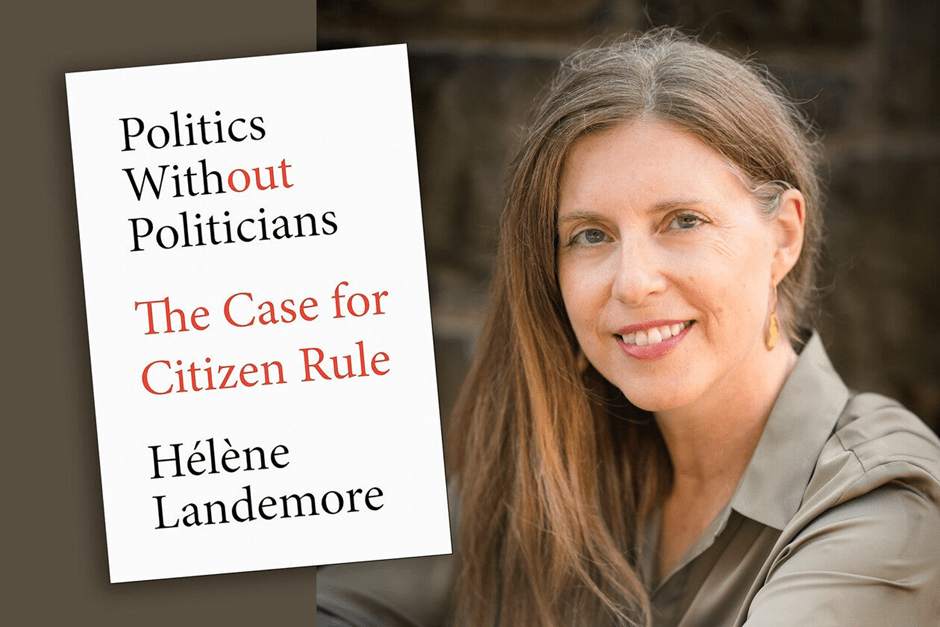
Yale political theorist Hélène Landemore has a soft spot for shy people — the wallflowers least likely to seek or desire power. She believes shy people should play a bigger role in governing. In fact, she argues they might be key to fixing democracy. In her new book, “Politics Without Politicians: The Case for Citizen Rule” (Thesis), Landemore makes the case that, under the right conditions, everyday people, even the shy, can govern more effectively than professional politicians. “Modern electoral systems tend to produce a professional political class — often composed of wealthy, well-connected, and ambitious individuals — that is detached from the broader public,” said the Professor of Political Science in Yale’s Faculty of Arts and Sciences. “The book argues for returning to the basic ancient Greek assumptions that politics is an amateur sport, not a professional activity, in which ordinary citizens play a direct role in governing.” Landemore advocates for citizens’ assemblies — bodies composed of randomly selected citizens who deliberate on public issues and make policy recommendations. These assemblies — examples of which have occurred in democracies across the globe — are designed to be deliberative and informed by expert testimony, she said, but ultimately guided by the citizens’ judgment
Are our individual and institutional responses appropriately calibrated to the scale and complexity of the moment we are actually in?
After all, we cannot “solve” planetary and geopolitical challenges at the level of curriculum, technology, or individual resilience. We cannot, and arguably should not, seek to extend an extractive system indefinitely. And when we try to do so and fail, we may erroneously conclude that we are just not trying hard enough, rather than re-evaluating our orienting premise.
Here is where the contrast between crisis-thinking and consequence-thinking can be instructive.
Crisis-thinking asks: How do we fix this system? Consequence-thinking asks: How do we live responsibly in the wake of the consequences of the system itself?
Crisis-thinking equates agency with certainty, control, and benevolence. Consequence-thinking reframes agency as our capacity to respond to uncertain, constrained, and ethically compromised conditions with discernment, reflexivity, and relational integrity, knowing we will likely make mistakes along the way and that outcomes are never guaranteed.
We are living in an in-between time. Old frameworks are still widely used, but increasingly fragile and distrusted, and new practices, possibilities, and points of intervention appear only in fragments. This is an uncomfortable place to be. It is also the most honest one available to us.
This piece has not offered a full reckoning with our contemporary moment, and with the colonial legacies that have shaped it. This is not because such a reckoning is unnecessary, but because it cannot be rushed.
However, my sense is that if higher education is to continue mattering in this transitional time, it will not be because we successfully restored what is ending, but because we learned, slowly, humbly, and imperfectly, how to reconstruct our research and teaching by asking what responsibility looks like when growth, continuity, and innocence can no longer be assumed.
In 1884, John Ruskin delivered one of the first lectures to discuss climate change and make a link to industrial pollution.
Now, with the help of a group of 13- to 16-year-olds, a new exhibition Sheffield’s unrivalled Ruskin collection is taking place at the city’s Millennium Gallery.
Storm-Cloud brings together work from the Guild of St George’s Ruskin Collection and is curated by young people, and includes video work by Jake Goodall and research by the University of Sheffield to explore the legacy of Ruskin’s groundbreaking observations.
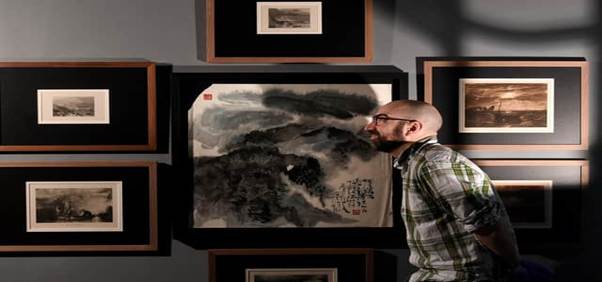
Ashley Gallant curator of the Ruskin Collection is pictured with selection of works by J.M.W Turner. Picture taken by Yorkshire Post Photographer Simon Hulme
“Ruskin delivered his pioneering lecture, The Storm-Cloud of the Nineteenth Century, after closely observing the sky over many years and concluding that the weather was changing,” explains Ruskin curator Ashley Gallant.
“He argued that a cloud wind’ was making the weather meek and mild and unpredictable and that the filth and smoke from industry from chimneys in the north were part of the cause. It was a very, very early understanding of climate change.
“The exhibition, Storm-Cloud: The Look of the Sky, takes this lecture, which was quite controversial at the time, as a starting point to present artistic and scientific observations of our sky and climate.”
Ruskin was passionate about getting people to actually look at the world around them rather than romanticise it, as was the fashion at this time.
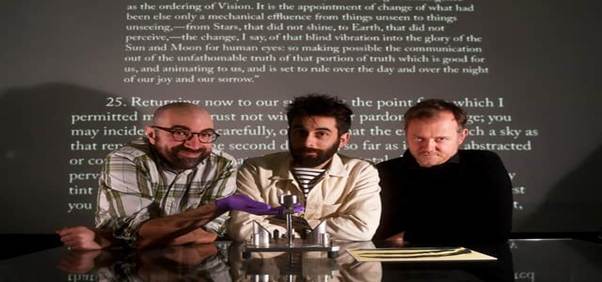
Ashley Gallant curator of the Ruskin Collection, Jake Goodall Senior Lecturer in Graphic Design at Sheffield Hallam University and Dr Tom Payne senior lecturer in performance at Sheffield Hallam University are pictured looking at a Rain Gauge and Sunshine Recorder Card Picture taken by Yorkshire Post Photographer Simon Hulme
“Among other things he was an artist fascinated by nature and his landscapes were more like photographs than edited and beautified.”
The new display is curated by The National Saturday Club, a group of 13 to 16-year-olds who meet weekly at Millennium Gallery to enjoy creative activities.
In 2001 the Ruskin Collection moved to the Millennium Gallery. Its original home was in Walkley, created by Ruskin himself 150 years ago and curated by his friend Henry Swan.
“Our education teams feedback that young people have a lot of climate change anxiety. The Collection itself is Victorian teaching collection, and we thought this was a great opportunity to work with young people on something they really cared about,” says Gallant.
“We decided we wanted to illustrate the lectures through looking at the sky and pulled out around 300 works from the collection that had images of clouds in and then we took quotes from the lecture, and the young people organised the images into the quotes which formed the basis of the sections of the exhibition.
“We then kept going back and removing and removing until we had four really tight sections. They then came back a month later and helped decide how each section was going to look.”
The result, says Gallant, means it looks different to most museum shows.
“They’ve completely changed the way we hang things, and they’ve made some really great choices and while we were working with them we could see them making the connections.
“The lecture goes from light to dark as Ruskin sees the weather changing and the show goes from light to dark in the same way.”
It also includes a new video work by Jake Goodall will be updated regularly throughout the exhibition and will go on display alongside research from the University of Sheffield, highlighting their work towards reversing climate damage by attempting to remove carbon dioxide from the atmosphere.
The display also forms part of an ongoing project which has been going for the last two years, Storm-Cloud, by Sheffield Hallam University’s Dr Tom Payne, who performs Ruskin’s lecture and invites artists to respond to the text by creating their own interpretations.
The project creates a growing collection of new art works or ‘notes and additions’, each responding directly to Ruskin and climate change.
Ruskin was a writer, art and social critic, artist and philanthropist. As an author he commanded international respect, attracting praise from figures as varied as Tolstoy, George Eliot, Proust and Gandhi and he was cited as an influence by Clement Attlee and the founders of the National Trust, among others.
He wrote on many things: art and architecture, nature and craftsmanship, literature and religion, political economy and social justice —a dizzying variety of subjects. He also worked tirelessly for a better society and his founding of the Guild of St George was one part of that endeavour.
The depth and range of his thinking, his often-fierce critique of industrial society and its impact on both people and their environment, and his passionate advocacy of a sustainable relationship between people, craft and nature, remain as pertinent today as they were in his own lifetime.
Simon Selligman of the Sheffield-based Guild of St George was created by Ruskin in the 1870s as a small educational arts and wellbeing charity.
“The Guild was very much inspired by the medieval Guilds across Europe of like-minded people coming together to make the world a happier healthier place.
“Ruskin came from a wealthy background so he never had to work for a living but rather than buy art for himself to fill a grand house his passion becomes how can art and access to nature and wellbeing help ordinary people who he felt were in danger of becoming machines due to the industrial revolution,” says Selligman.
“He had profound anxiety that this was not good for human beings and that human beings need access to beauty in nature and art inspired by nature.
“A lot of things in the Collection, that he created for the public good, are from him sending artists off across Europe, particularly to Venice which he loved, to draw or paint beautiful things and bring them back to Sheffield for working people to have direct access to them.”
Selligman says Ruskin’s plan had been for a number of similar museums and they would all be called St George’s Museums.
“He saw St George as symbolic figure, being brave, confronting the ills of society and Ruskin saw the dragon as industrialism.”
But in the end Walkley became the first and only museum.
“People had to walk through nature to get to the museum high up where the air was cleaner, to what was in essence a cottage he bought and extended which housed these extraordinary things form all over Europe which he hoped would inspire.
“He really admired the craftsmanship of the tool makers of Sheffield and he wanted them to see that they were artists too.”
And what does he think Ruskin would have made of today’s exhibition of his collection in the Millennium Gallery?
“I think he would have been very inspired by what Ash is doing.
“What the museum is now doing is say look we can break open this collection and get it into the dialogue of the issues of today and I hope Ruskin would have loved that. He was engaged with the issues of the day.
“I hope he would have been excited by it but one of the things about Ruskin was that you could never predict him.”
The Ruskin Collection: Storm-Cloud – The Look of the Sky is on at the Millennium Gallery, Sheffield until Sunday November 29
Battered by the storm, Cornwall was emblematic of our institutional systemic failure to confront a rapidly changing reality. In one of the richest countries in the world, entire communities lost power for weeks, and running water for days. Had the British government addressed climate change, and made contingency plans for these mega-storms, which will only become more frequent with time, the residents of Cornwall may not have faced such dangerous circumstances in the coldest month of the year. Yet, despite its great beauty, and the acute, localised housing crisis driven by the number of properties kept as second homes for wealthy Londoners, Cornwall is impoverished. This large county comprises of mostly rural communities who have been largely forgotten by a post-industrial economy which sees no value in that which cannot be scaled to maximise profit.
Cornwall enjoys an impressive network of self-organised resistance, from food co-ops and foraging workshops to marches and those willing to risk jail. It is interesting how varied and impressive this network is but seems to have very little to offer by way of suggestions for how to navigate the great eroding they are all living through. But is striking as it so often does in any discussions with locals how easy it is to veer into conversations about national or even international problems and potential actions to take. Probably the best path for all resistance is what has been called hyper-localised and intimate. Only when we know our neighbours and know what they need, what they seek, can we begin to generate the kind of common ground which becomes fertile soil for the common good. Only when we know our land and all the relationships that depend on it can we implement alternative systems which support one another and nurture life. These are the shelters which will see us through the storms.
The deep tentacles of corruption spread over the political landscape, creating dark shadows on the surface of the Earth. We cannot combat like with like, not within a time of such huge inequality. Limiting our sphere of influence to our geography does not limit the kind of action we can take; these are the roots which hold the soils together, deepened by time and commitment. If every community in every place were to begin digging deep into themselves and one another to create the root system which will support them all through our dangerous future, this would change the very nature of our local and global problems.
In an interconnected world, adaptation and resilience strategies must also be outward facing. This means recognising that risks are not evenly or justly distributed geographically, and accepting responsibility for helping the people and places that face the most acute threats. This imperative is all the stronger when looking at countries, including former British colonies such as Bangladesh, that are far poorer than the UK and for whom it is far harder to prepare and adapt.
This wide ranging and impressive report addresses two distinct but interconnected dimensions of climate impacts, each relevant to different decision-makers: (1) economic impacts affecting financial asset values and portfolio performance over investment horizons, and (2) broader social and human welfare impacts, including mortality, health burdens, inequality, ecosystem degradation, and quality of life. The first is directly relevant to pension funds, institutional investors, financial regulators, and central banks using climate scenarios for stress testing. These include GDP losses, capital destruction, productivity declines, and disruptions to revenue streams that translate into asset price changes.
Specifically, this report addresses several shortcomings in current approaches to forecasting economic impacts, which analysts at government treasuries and economic advisory agencies may find particularly constructive. The second point is the primary concern of policymakers, governments, and civil society, particularly regarding vulnerable populations and distributional justice.
While these audiences have distinct mandates, we argue they cannot be cleanly separated in climate risk assessment for three reasons: (1) social impacts become economic impacts, (2) fiduciary duty extends beyond pure returns – and increasingly so -, and (3) current models systematically miss material risks by excluding social dimensions. Ultimately, climate change carries systemic risks that – when taken together – threaten the long-term financial stability that supervisors and regulators across the globe have a mandate to protect.
The purpose of house building should be to increase the stock of homes for local people. If new developments cause flooding of existing housing stock, and this renders existing housing uninhabitable and uninsurable there is no net increase in housing stock (What if floods left your home unsellable? 2 January Guardian).
Matlock repeatedly suffers from surface water flooding, from the hills above the town. In the past six years the centre of Matlock has been flooded each year: this never used to happen. Climate change linked to more frequent and intense rainfall , coupled with new housing developments in the hills above Matlock is causing a significant increase in surface water flooding in the town.
Planning for new developments was simply not paying enough attention to the impact of flooding on building situated directly below them. A clear example of this was a proposed new housing development for 430 homes on the hillside above Matlock. This area, called the Wolds, is greenfield agricultural land that currently acts as a sponge to soak up water during heavy rainfall. To attenuate surface water flowing from adjacent tributaries and enhanced by the new houses the developers proposed to build large ponds(Sustainable Urban Drainage) which would sit directly above the town.
The plan, proposed by the developer underwent five years of rigorous scrutiny by democratically elected Council and residents. It was rejected by the Council’s planning committee in March 2024, for several reasons, one being that they could not be confident that the public would be safeguarded from flooding from the proposed large drainage ponds. In addition, there was no affordable housing being provided and many rich biodiverse habitats would be removed.
However, the developer did not agree, and they appealed against this decision. The Planning Inspectorate hearing took place over 8 days from Tuesday 11th March 2025. However, at a secret Council meeting in January 2025, District Councillors decided they were no longer able to defend their refusal of this development allegedly because they might incur huge costs.
A handful of residents formed the Matlock Wolds Action group(WAG) just over a decade ago with the purpose of protecting this unique place. Some of the tributaries from the Wolds serving as the hydraulic engine of Richard Arkwright’s Industrial Revolution, and Matlock, then a small market town, became more prosperous and famed as one of the largest Hydrotherapy centres in the UK.
Over time, the WAG group grew stronger, in response to the intense and unacceptable pressures from both the council and the developer. WAG’s members and supporters, people from all walks of life, knew that the well- being of Matlock was under threat from yet more concrete and tarmac. The bond of a common goal, together with a deep mistrust of authority, grew friendships, mutual respect, trust and strengthened resolve. People pitched in with whatever skills they could offer. And they were prepared to learn. A clear example of citizen science coming to the rescue in a town in crisis. In September 2022 the British Academy funded a research study on flood resilience in Matlock. The research published in January 2025 found evidence of strong community network formation -localised networks that emerged during a time of crisis and existed for the 6 years leading up to the planning appeal.
Finally, things came to a head when the WAG agreed with the Council to form a Rule Six Party to support the council but when the council capitulated, the group was left to put up a solo defence. What surprised everyone was that the appeal was dismissed by the planning inspectorate, one reason being the risk of surface water flooding. When abandoned by the official experts and authorities, citizen science provided the crucial evidence in what became a modern-day David Vs Goliath story.
“Universities have been with us on this Earth for at least one thousandyears and will surely be with us in the future; perhaps so long as there is life onthis planet that has any well-being. There is now something in not just the nameof the institution but in the idea of the university that seems to have durability.But the question imposes itself again: just what is it to be a university?(Barnett,2011)”
Ronald Barnett sets out a masterly critique of our ideas of a university. By offering a forensic analysis of their past and present trajectory he posits that there is a positive and ontological case for the evolution of an Ecological University. As he argues, we need to develop feasible utopias as part of what he describes as social philosophy, with a critical edge ,which seek to develop ideas which address the question of how to create universities which might be the best fit for this world, and not the best in all possible worlds.
These ideas are perpetuated and reinforced in a world of increasing uncertainty and unpredictability. Hence, there are strong arguments as advocated by Facer(2021) that business as usual is an insufficient response to the crises of the COVID-19 pandemic and the Climate Crisis. In these circumstances Barnett coins, the descriptor –the therapeutic university—a stance based on the idea of helping the world live purposely with uncertainty-which he advocates is based on the reality that the world cannot be controlled and that for any university, control is an anathema to their core values. And its pedagogy becomes less epistemological and more ontological in character. In this orientation its policies and practices play out in its concerns for human flourishing and the connection to the wider dimension of well-being along with concerns about ethical dilemmas.
But most of these orientations have both negative and positive and even pernicious possibilities. Another more acceptable alternative offered by Barnett is the idea of the authentic university. – one that is true to itself. But as he argues the pushes and pulls from its environment make this hugely difficult especially those that come from regulation and funding mechanisms. Hence, he questions whether we can realistically speak of a responsible university, because these external pressures make it impossible to speak of the university and authenticity in the same breath. His answer is that these apparent tensions between authenticity and responsibility -between the inner and outer calling of the university can be resolved by a different concept – the Ecological University.
This is a university which seriously focusses on both its interconnectedness with the world and the interconnectedness of the world. Its tangible learning outcomes being towards developing students as global citizens with a care or concern for the world and their contribution via civic engagement towards the realisation of a more environmentally and socially just sustainable world. This characterisation also encompasses the idea of a networked university– which engages actively both locally and globally to bring about a better world.
“This is a university neither in-itself( the research university)nor for itself(the entrepreneurial university)but for others. Or we might even say simply, for -the-other, for the ecological university has an abiding sense of alterity ,of there being external realms to which it has responsibilities, even while holding fast to its traditional interest in the emancipatory power of understanding for enlightenment”.
Ronald Barnett (2011) The coming of the ecological university, Oxford Review of Education, 37:4, 439-455.
Keri Facer(2021) Beyond business as usual: Higher education in the era of climate change. HEPI Debate Paper 24.
The cost of electricity produced by solar power has been falling for the last two decades. This trend is likely to continue due to the increased efficiency of panels, lower cost of silicon, improved manufacturing techniques, and economies of scale – the higher the demand and deployment, the lower the cost. Costs have fallen by 80% in the last 10 years.
In the UK, electricity from solar farms can be sold for as little as 5p per kWh. In sunnier countries it can be produced at even lower prices – cheaper than any other renewable or fossil fuel competitor.
Solar Panel Efficiency
In the early days, standard silicon panels could convert around 6% of sunlight into useful electricity. By the early 1990’s this had increased to 15%, which along with falling costs made them commercially competitive for the first time. Solar panels are now around 22% efficient. These improvements have been achieved through research and innovation into new materials, and cells that capture a wider range of the light spectrum. Innovation continues, for example, perovskite cells may capture even more than the current silicon-based panels.
Where can Solar be Deployed?
To maximise solar radiation at mid-latitudes, solar panels are best deployed at an angle, either placed on the ground or, in the northern hemisphere, on a south-facing sloping roof. Nearer the equator they can be deployed horizontally on roofs or laid flat on the ground. I have also seen solar panel arrays in Spain that track the sun during the day, increasing their output by 30%. Although not as efficient, they can be deployed vertically, for example on walls.
Solar is very compatible with offices, schools and other public buildings which are mostly occupied during the day. It is also compatible with the global increased demand for air conditioning which often coincides with hot and sunny weather.
Traditionally there were two main categories: solar farms and rooftop solar – sub-divided by commercial and domestic roofs. Now there are far more options:
Floating solar panels on reservoirs can supplement hydro-electric power
Solar panels above irrigation channels help to reduce evaporation
In arid regions, solar panels power irrigation water pumps to replace diesel generators
Railway companies are deploying solar panels alongside their tracks, and they can be deployed along road verges to double up as sound barriers
Solar panels on the bonnet and roof of an electric vehicle can increase its range
France requires the owners of car parks to deploy solar panels above car park spaces, to feed into electric vehicle charging points or to the grid
Solar panels can be installed on multi-ownership apartment blocks with the electricity supplied to each apartment
Germany allows residents to deploy vertical plug-in solar panels on apartment balconies without any complicated electrical connection
Innovation
Solar panels lose efficiency when they overheat under a hot sun. At the BE-ST innovation centre in Hamilton, water is circulated under the solar panels to reduce this overheating and increase the panels’ efficiency. Then this warmer water is used to pre-heat a heat pump which also increases its efficiency for space heating.
Bifacial solar panels on solar farms capture sunlight on the front and rear surface, taking advantage of reflected sunlight.
Roof tiles can function as solar panels which enable all the roof area to generate electricity, also avoiding the extra weight of panels on a roof. Solar windows can generate electricity whilst allowing light to pass through. Imagine this deployed in every skyscraper.
An important new development is solar cells made from perovskite. This enables thinner and lighter panels and can use a wider range of the sun’s rays. These ultra-thin and flexible panels can be integrated into clothing and fabrics for a wide range of new uses.
Manufacturing
Solar panels are primarily made of silicon, which is a semiconductor material that converts sunlight into electricity. Other key components include glass, which protects the cells, and aluminium, copper, and silver, used for the frame, wiring, and electrical contacts. Silicon is an abundant element that comes from sand and quartz of which there is no global shortage.
Global Growth
Electricity supplied by solar is growing exponentially. Rising from less than 1% in 2010, to 3% in 2020 to 7% in 2024. In 2024 solar generated 8% of electricity in China, 7% in the USA, and even 5% in the cloudy UK. The highest penetration of solar in the world is currently Namibia (38%), followed by Lebanon (31%) and Hungary (24%). Sunny Saudi Arabia has a paltry 2%, with Algeria by the Sahara desert only 1%. There is clearly scope for much more growth. [Source: Our World in Data].
China has been adding solar capacity at an impressive rate. In 2024 it installed more new solar capacity than the rest of the world combined. There is a ‘glut’ of solar panels manufactured which they are now selling cheaply to countries like Pakistan. Pakistan is one of the fastest growing solar countries in the world. Solar generation increased from 4% to over 10% in the 3 years to 2024. In 2024 alone, new solar added an additional one-third to its entire generating capacity.
In the UK 1.5 million homes have solar panels, around 5% of all houses. Solar farms take up around 0.1% of UK land which may increase to 0.4% in the coming decade to help meet the UK’s net zero electricity target.
Limitations
All solar farms have an impact on land-use and habitat, and I do sympathise with not blanketing the countryside around villages. Solar farms have, quite correctly, been criticised for spoiling the countryside and taking away prime agricultural land, or for destroying rare desert habitat. However, if wildflowers grow beneath the panels, then they can increase pollinators like bees and moths. They can also be integrated with agriculture – agrivoltaics – providing a diversified income for farmers. Sheep can graze beneath solar arrays. In hot countries some crops grow better under solar arrays as the shade reduces harsh day time temperatures and reduces evaporation.
Of course, solar panels only operate during daylight hours and generate far less electricity when it is cloudy. For this reason, they work best in tandem with battery storage. The cost of batteries continues to fall, but that is for another blog.
At high latitudes there are extremes of daylight and hours of darkness which undermine the ability to rely on solar panels. Snow can also prevent solar panels from operating. Areas exposed to violent hailstorms are also at risk as hail can damage panels.
My Home Experience
In 2010 I bought twelve 175w solar panels generating a maximum of 2.1kW for £10,000, subsidised by a generous feed-in-tariff. In 2022, I bought a further ten 250w panels, generating a maximum of 2.4kW for £4,150.
Allowing for inflation, this is a 74% reduction in cost per unit of electricity generated,
The more recent panels, at 22% efficiency, generate more electricity from a smaller roof-space than my original 15% efficient panels.
I generate around 3,200kWh per year, more than the 2,900kWh an average household uses in the UK. Of course, I use more than this as our household is highly electrified with a heat pump and an electric vehicle.
The exciting development is that the second set of solar panels didn’t require a subsidy to encourage me to buy them. If you have a south-facing roof they are now a worthwhile investment.
Solar Equity
Solar panels use energy directly from the sun. They are more efficient and clean than other forms of energy. Fossil fuels are produced indirectly from photosynthesis from the sun and millions of years of geological processes. When you burn fossil fuels, most of the energy is ‘wasted’ as heat and harmful gases are released. Reliance on fossil fuels has created a world of energy ‘winners’ and ‘losers’ and huge geopolitical instability. Solar will be more democratic. It is available in every country, and can be harnessed at scale by multi-national corporations but also by schools, community groups and individuals in their own homes.
The Future
Electricity direct from solar cannot be relied on 24/7. Gas or even hydrogen could provide back-up power, but if a country wants to rely on a near 100% renewable supply, then there are four possible courses of action:
Build long distance inter-connectors to import/export electricity
Demand management services
Storage
Build over capacity
Options 1, 2 and 3 will always have a limited duration and capacity. Historically most storage has been pumped hydro, but the cost of lithium-ion batteries keeps on falling and has become viable. A surprising conclusion is that building massive over capacity is a realistic proposition. If solar becomes so cheap to generate, then why not build sufficient capacity to supply our demand on cloudy days.
A combination of these 4 options will be the most cost and resource effective.
Conclusions
We have recently entered a ‘new world’ where solar is the cheapest form of electricity generation. This will speed up decarbonisation in wealthier countries and provides a golden opportunity for every citizen in less wealthy countries to access electricity including those living in remote rural areas.
I don’t have many recommendations from this blog. Solar growth is happening through market economics without the need for further policy interventions. But I do hate to see new buildings constructed without any solar panels, or even worse, a couple of ‘token’ panels mandated to meet a minimum building regulation standard.
In the UK, all new homes should be built with the maximum number of solar panels. Also, subsidies, loans or an easy to access installation service should be offered to help those on lower incomes install panels on existing social and private houses.
“An elevator-pitch definition of fear might be a neurobiological process to keep us alive,” writes cultural historian Robert Peckham in his 2023 book, ‘Fear: An Alternative History of the World.’ Indeed, fear – that full-on jolt of adrenaline we feel throughout our body – has served humanity well. It kept our early ancestors alert to danger and ultimately enabled the human species to survive and evolve to where it is today.
In modern times, negative emotions continue to play a key role in how we function and navigate our complicated and emotionally layered lives. Fear alerts us to immediate threats and rouses us to act, thanks to its urgency-inducing parameters. Fear, at its simplest, is the trigger of our fight-or-flight mode.
Sadly, our survival instinct and fear response struggle with far away events, those out on the horizon. The climate crisis and the breakdown of planetary life systems are two that come to mind. Hearing that the current year is the “hottest on record,” or that we continue to miss the Paris Agreement’s targets for reducing carbon dioxide (CO2) emissions, appears to have little impact in galvanizing the response that is so urgently needed.
However, attempts to stir up fear, anger, or shock towards these topics and others point out the flipside of fear: too much of it can paralyze us, leading to inertia or emotional shutdown to avoid feeling overwhelmed. In some cases, well-intended communications and outreach campaigns have arguably prompted the opposite effect of what is desired. Instead of moving people into action, such strategies have provoked public backlash against the very organizations and individuals trying to create mobilization.
While fear and other negative emotions have their rightful place in the communications and advocacy toolbox, relying on them exclusively is akin to having just one tool. A more diversified set of approaches is required to solve a problem. So, the question becomes, what other emotional tools are at our disposal, and how do we shift the emotional dial in a direction that triggers long-term engagement and concrete behavioral change?
Answers and clues to this question lie at the heart of a new global conversation on hope and other positive emotions, one that has prompted the UN to declare 12 July the International Day of Hope. The research and work we have been doing through our respective institutions and with our partners point to the need for more hope. This is not a fluffy, feelgood proposition, but one backed by facts.
But first, why hope? Because hope is forward-looking. It depicts in our minds a picture of a future worth striving for, which can be a far more potent motivator over the long term than fear and doom alone. Hope offers a sense of possibility and helps overcome the desperate feeling that nothing we do will make a difference.
Recent research in the field of affective science shows that, among positive emotions, hope packs a particularly strong punch in helping us find our way through challenges. What is more, the positive effect of hope appears to be nearly universal. Studies conducted across different cultures found virtually no cultural variation in the power of hope. That is a striking finding. It suggests that harnessing hope could be a globally resonant strategy, a rare emotional common denominator in a world that is in crisis.
Of course, hope on its own is not a panacea to the world’s ills. Used in isolation, hope can be just as off-putting and demotivating as fear. The notion of “false hope” – the kind that assumes “everything will work out on its own” or that “someone else will fix it” – isn’t the kind of hope we are advocating for. The hope we need is the belief in a positive future, paired with the willingness to work collectively towards change. This is the kind of “constructive hope” that, for instance, powered civil rights movements.
Importantly, the relevance and power of hope are now being recognized at the highest levels, notably through this first International Day of Hope. The resolution establishing it, adopted earlier in 2025, calls on UN Member States to recognize“the relevance of hope and well-being as universal goals and aspirations in the lives of human beings around the world, and the importance of their recognition in public policy objectives.”
The International Day of Hope gives the necessary boost to mainstream the insights garnered on hope and the broader field of affective science into how emotions can drive change for people and the planet in the long term. Notably, the resolution clearly stands in opposition to the emotionally negative and psychologically disruptive tactics being used by different political movements to placate citizens into inaction. It encourages bringing what we know about emotions into the multilateral space, where it should be applied to negotiations and policymaking to overcome the growing gridlock and apathy in diplomacy.
Crucially, the kind of hope being advocated for today is collective hope. It is not about lone individuals each feeling optimistic – it is about forging a shared sense of purpose and possibility. Climate activist and author Bill McKibben put it best: “the most important thing an individual can do is be somewhat less of an individual. Join together with others.”
On this inaugural International Day of Hope, let us take stock of our emotional toolkit. Fear will remain a useful resource, jolting us awake when complacency creeps in, but we need to lead with hope.
This is our elevator pitch for hope. It is humanity’s other survival mechanism. Fear was a vital emotion that helped early humans survive and evolve, but hope will help us thrive.

 transformativefuturelearning.home.blog