In an earlier blog, I explored the ideas of objectivity and subjectivity and how different world views impact on our understanding of reality. In 2002 philosopher John Gray also explored these issues and their impact on human thought in a book called Straw Dogs. He wanted to attack the unthinking beliefs of thinking people. The book is a powerful and withering critique of liberal humanism, one of our dominant worldviews. He suggests that “The prevailing secular world view is a pastiche of current scientific orthodoxy and pious hope”. Which from a Darwinian perspective reinforces the fact that we are animals but which those who call themselves Humanists rail against because they argue that unlike animals, we have choices – or free will. But the idea of free will has its origins not in science but in religion. Not just any religion, but the Christian faith itself! This dichotomy underpins our failure to respond to the existential threat of climate change and our unsustainable lifestyles. We are beset by a huge array of false news, self-illusion, echo chambers, myths, and stories. Our beliefs do not map onto the actual structure of the world (reality). This makes it increasingly difficult for us to make rational, evidence based and logical decisions. This cognitive dissonance between belief-systems and rational thought and action is a major issue and unless we confront it, we will make no real progress towards the goal of a sustainable future.
Gray goes much further and critiques the “religion of Humanism” and its post Christian faith in humanity’s ability to make the world better through scientific advances; their idea of progress he argues is a secular version of the Christian belief in providence or the divine guidance from God. However, our belief in progress has other origins. The growth of scientific knowledge is cumulative whereas human life is not since any gains in knowledge in one generation may be lost in the next. Our pursuit of more knowledge from all its sources is a mixed blessing. It has offered us longevity along with better living standards and at the same time has allowed us to wreak havoc on a planetary scale. Scientific progress has been a huge part of modern society. But an equal emphasis has not been placed on the application of ethics as an integral part of scientific enquiry. Scientists are meant to be objective; they are not required to think about the social implications of their research. Knowledge and scientific progress are simply deemed to be good for their own sake. But as the following example points out this inequality between science and ethics has had devastating impacts.
Take a specific example, like the right to bear arms which is protected under American law by the Second Amendment. This is undoubtedly a controversial topic, and one that’s been even more fiercely debated since there have been innumerable school shootings recently. Many of which resulted in multiple deaths and injuries (in 2018 there were 8 making 18 school shootings in total). Is this still a necessary legal entitlement in the 21st century, given that since 1887 ,when this legislation was passed, there is no longer a “Wild West?” Coupled with the fact that scientific progress has resulted in the development of semi-automatic guns which allow one person to kill so many more people than the guns that were around in 1887. Is it in any sense ethical for a politician to support the continuation of this law?
Is humanity’s search for progress to be shaped only by its longing for immortality or should it be based on our yearnings for a good life as an integrated part of a self- sustaining biosphere? Maybe this implies the need for a clear and unambiguous ecocentric theory of ethics as an essential prerequisite to the creation of a more sustainable world and one in which a programme of green citizenship based on virtue ethics, plays a significant role? Could this provide a philosophical blueprint for a more balanced, sustainable world.
I was invited to a virtual event last Sunday by WWK-UK to hear from Sir David Attenborough about his new film on Netflix.
A Life on our Planet is a feature-length documentary which tells the story of life on Earth and the ecological changes of the last century, many of which have been filmed and orated by this influential 94-year-old commentator.
It is what he describes as his “witness statement”, as a conservationist who has visited every continent and made countless hours of TV programmes about the planet. A Life on Our Planet explores how natural habitats have changed and how we can save them.
Attenborough said he has had an “extraordinary life”, but “we are replacing the wild with the tame.”
It is quite an extraordinary message – a witness statement from a single individual who recently reached a record 1 million followers on the social media platform Instagram!
Will the message resonate I wonder? Geological time versus an individual’s lifetime – can it light humanities “blue behavioural touch paper” and transform our consumerist lifestyles?
Another extraordinary feature of the film is that it starts in Chernobyl where there are still no humans living there following the massive explosion which released radioactive Caesium around the globe. Yet, there is an abundance of other forms of life , but an eerie silence, no birdsong and a haunted feeling about its former inhabitants – with school notebooks left on the floors of empty schools. It represents a world of nature without Humans.
The documentary, created with Silverback Films and environmental organisation WWF, looks at some of the biggest challenges our planet is facing today, while also offering a message of hope and solutions into what can be done to stop this trend of destruction.
Attenborough advocates that “Saving our planet is no longer a technological problem, it’s a communications challenge.” I agree.
The film does not just focus on the negative but tries to show how things can improve if humans do things such as rewilding areas and using renewable energy. As with any Attenborough documentary, the film features stunning scenery and wildlife footage from around the world, but also devastating shots such as large chunks of polar ice melting and all-encompassing pollution.
The film makes suggestions on how we can reverse the planet’s decline, such as with the use of renewable energy.
Film director Jonnie Hughes said of Attenborough: “He has witnessed a serious decline in the living world over his lifetime (he began filming in 1954!). He has seen the rainforests retreating and the grasslands emptying and has searched ever harder for species hanging out in hidden corners of the world.”
He added: “He is dedicated to lending his considerable profile to efforts to halt and then reverse this decline, and he’s in a good place to do so.”
Universities are much in the news, but it is not good news. The rise in the pandemic R number in the UK is having a profound impact on university students as they return in their thousands to campuses to find in many of them that they face total lockdown. So, no immersive quality campus experience for them, as the virus spreads amongst them.
We hear from university leaders about how they are creating more online teaching with mixtures of blended learning which they claim will offer a different but high-quality experience. But I do not hear how this will reflect on the learning outcomes for those exposed to this new regime nor of the job prospects in a post covid world?
Nor is there a clear message about the contribution universities can make to societal transformation, as I have argued in some earlier blogs. Especially in those which advocate their potentially significant role in civic renewal.
A recent blog by Otto Scharmer at Massachusetts Institute of Technology has seriously questioned their role in contributing to social progress. I agree, with him their role is very unclear. And this is clearly not on the policy radar for the Department for Education or Universities UK and more importantly it is not a priority for the university quality and standards regulator-the Office for Students.
The problem is lack of political will and a “knowing-doing” gap, which Otto calls “a disconnect between our collective consciousness and our collective action.” All of which leads to social breakdown, political unrest, and massive environmental destruction, including the extinction of our planetary biosphere.
He argues that as we move from one geological epoch-the Holocene to the Anthropocene it is time to reconceive the 21 Century University.
He explores these issues by mapping our current actions onto a set of Operating Systems(OS)-set out below.
In most of the sectors above he suggests we are stuck in OS levels 1, 2 and 3 and seem unable to progress beyond to level 4.
“The main problems in our universities and schools today is the lack of vertical literacy. Vertical literacy is the capacity to lead transformative change, i.e., to shift the level of operating from 1.0 and 2.0 to 3.0 and 4.0 as needed by:
· seeing yourself — i.e. self-awareness — both individually and collectively · accessing your curiosity, compassion, and courage · deepening the space for listening and conversation · reshaping the type of organizing from centralized to ecosystem · cultivating governance mechanisms that operate from seeing the whole · holding the space for profound transformation: letting go and letting come”
University Vice Chancellors and their deans largely operate at OS level 2(education). Whilst there are some exceptions(see my blogs on Arizona State University President Michael Crow), most exhibit epistemic myopia when it comes to building the capacity for vertical development towards level 4. “They think and operate in terms of horizontal development — for example, adding another skill here or another course there — not in terms of vertical development, which essentially deals with the evolution of consciousness. To use the analogy of the smartphone: they think in terms of adding another app, not in terms of upgrading the entire operating system.”
Plutarch argued two thousand years ago that “Education is the kindling of a flame, not the filling of a vessel.” But education keeps on filling and often drowning the recipients! As Richard Bawden and colleagues at Hawkesbury College in New South Wales found there are innovative ways of learning that avoid the “knowing-doing gap”
The key for them was to shift the place of learning from campus to community. They knew that students learn better by doing. So, they created action learning programmes in rural communities where the student becomes the change agent, and the teacher is the coach, the helper who holds the space for the learner to facilitate their highest potential. Developing action learning at scale requires quite different learning infrastructures, including classrooms that are not primarily about content delivery but about reflection on action, which requires a different type of faculty that can hold the space for student-centred forms of learning.
“Learners and change makers must cultivate different ways of knowing. While action learning shifts the outer place of learning from the classroom to the real world, whole person learning shiftsthe inner place of learning from the head to the heart, and from the heart to the hand. Activating these different intelligences requires a deepening of the learning process by cultivating curiosity (open mind), compassion (open heart), and courage (open will).”
If we are to transform our universities to meet the 12 principles advocated by Otto, then we need to co-create with students and communities a new and adaptive “Ecological University”. In my view this can only be achieved through a process of deliberative democracy involving students, academics, and the communities which the university serves (see my earlier thoughts on Civic Universities and Civic Agreements in Holland). And learners must become adaptive ecosystem leaders and as such become context and place based- change-makers. They will need the competencies to convene a diverse group of stakeholders and partners and then take them on a journey from a silo to a systems view, from” ego-system to eco-system” awareness. Creating the sustainable and ethical space for such a journey is at the heart of all major leadership challenges today. It is a capacity that is largely missing in organizations and insufficiently developed in our Universities. Our Universities could then offer real-world platforms and ecosystem partnerships in the cities and regions that they are embedded in and enhance that capacity by providing relevant out of classroom learning laboratories for student participation and learning by doing.
I have just watched a short video(made in June 2020) of Michael Crow-President of Arizona State University articulating clearly and convincingly this university’s approach to learning post Covid. I would describe it as visionary, comprehensive and accessible, along with many new features; one in particular called by the extraordinary name “Alien Zoo” which they are developing with the help of Steven Spielberg and Dreamscape ( https://www.topionetworks.com/people/steven-spielberg-55b118feba49fadb550005a4 ) As you might imagine it is extra-terrestrial too and linked to ecosystems and planetary sustainability. My only concern is the focus on the acquisition of knowledge and knowledge creation and limited reference to its wise social and political application . You can view his talk here: https: //youtu.be/LilG6ekrpjk Is this the creation of a transformative and adaptive 21 Century University?
Guest blog by Judith Krauss (SIID), Stephen Allen (Management), Renee Timmers (Music), Phil Warren (Animal and Plant Sciences) and Matt Watson (Geography)
How important is it to reflect on environmental aspects as part of research integrity and ethics? On 5 June 2020, an online-only workshop supported by the University of Sheffield’s (TUoS) Research Ethics Committee took place to begin answering this crucial, but challenging question.
The workshop, which was organised collaboratively by the authors, was conducted virtually through Blackboard Collaborate. The participants were from a diverse range of disciplines at TUoS (including, Neuroscience, East Asian studies, Animal and Plant Science and Philosophy), different geographical backgrounds and career stages (PhD researchers to Professors).
The workshop included contributions on environmental campaigning, carbon accounting and Higher Education activities in the ethics and environment space. It was intended to initiate a conversation within TUoS about the potential inclusion of environmental aspects into research ethics and integrity, if we should be doing this, and how this could be achieved. The outputs generated included a report (available from judith.e.krauss@gmail.com) and a creative summary by artist Luke Scoffield (enclosed with this blog).
Listening to learn
The first contribution came from Prof Fraser MacBride, Chair of Logic and Metaphysics at the University of Manchester. He reflected on his successful experience of campaigning for an environmental policy within his discipline, explaining the motivations and principles underlying the document. The British Philosophical Association’s environmental policy is now supported by 23 departments and 7 learned societies and commits signatories to researching responsibly given accelerating climate change. Significantly, among a multitude of e-mails that Fraser received in response to his requests for support, none raised significant ethical questions along the lines of ‘What do we owe future generations/nature?’ – there was a general acceptance of a debt. Objections rather focused on what the policy would mean for personal or professional lives, referencing employers’ emphasis on travel through promotion and probation processes, the heavy reliance of academia/REF on international networks, the potential limitations of an individual’s actions, or annoyance that the policy was not radical enough.
The second contribution was from Prof John Barrett, Chair in Energy and Climate Policy at the University of Leeds, who explained how a very sharp decline in carbon emissions is required to attain net zero in the UK by 2040, but how this rapid decline is not happening. He highlighted how carbon accounting at an organisational level includes both direct emissions (i.e. company-owned vehicles, fuel combustion) and indirect emissions (e.g. purchased electricity/materials, waste disposal, employee travel). Reflecting on his involvement in carbon reduction initiatives at the University of Leeds, he described how an analysis by Townsend and Barrett (2015) showed that ca. 80% of carbon emissions are indirect emissions (e.g. occurring in the supply chains of purchased goods and services), over which the University has less control. Nevertheless, the University makes decisions about how to manage their buildings, a high contributor, departments decide how to organise labs, principal investigators define how research grants are spent (e.g., is budget allowed for low-carbon travel or procurement options?). A key message was not to give responsibility for carbon emissions solely to Sustainability Services, but to embed this responsibility across the University, e.g. through questions around ‘Have you considered …?’ at the point of purchase, or in procurement forms. From John’s experience, asking questions and monitoring activity can raise awareness and reduce carbon even without a hard target.
The third contribution by Judith Krauss, supported by the rest of the organising team, illustrated how various ethics and integrity frameworks and policies (e.g. EU 2013,UKRI 2013, UKRI n.d.) include references to the environment as part of a broader ‘do no harm’ principle. However, this does not necessarily translate, e.g. in the REF or in universities’ ethics policies, into systematically considering the potential ecological consequences of the choices made about how research is completed. A notable exception that was mentioned is the ethics approval process by the University of Edinburgh’s School of GeoSciences and its explicit consideration of the climate emergency and other environmental considerations. Conversely, many environmental measures e.g. around reducing flying (Tyndall or University of Iceland travel policies) do not make explicit any ethical or moral reasoning. The two drivers – ethics/integrity vs. ecological initiatives – start from different places and would require careful integration to be able to respond to a key question: if we wish to integrate environment with research integrity and ethics at TUoS, how do we do this in ways that are generative and constructive and not ‘just’ a box-ticking exercise?
Let’s apply this to our work
In the second part of the workshop, small group discussions firstly acknowledged considerable environmental impacts of our research, ranging from flying via plastics used in lab settings or working with endangered species and habitats, to electricity for on-campus work.
Secondly, there was widespread strong agreement, especially in line with student voices, that these environmental impacts are very much ethical considerations. Importantly, ethics specialists emphasised that, since TUoS research ethics policy is concerned only with research involving human participants, they would have to be considered under the research integrity remit.
Thirdly, it was agreed that there is a critical need for education and action across TUoS beyond any formal processes and policies, though there is a need not to place additional excessive burdens on individuals/early career staff and recognise that different disciplines have different needs. For example, including a slide in research presentations about carbon emissions generated through the completion of the research could start to highlight possibilities for change in research culture. Also, it is important to recognise positively when individuals make decisions about research activities (e.g. not flying to a conference) which are based on clear environmental considerations. There was also discussion about potential lighter-touch research integrity evaluations of all research projects to take into account environmental aspects.
So what do we do now?
In summary, there was broad agreement that it is important to consider the environment as an important intrinsic element of research integrity and ethics. Participants suggested that they found the workshop to be a useful space for learning and discussion, which encouraged them to pursue action in their respective contexts. Their one-sentence summaries of key take-aways included wanting to change departmental policies, showcasing people who complete their research in environmentally conscious ways, and the need to make institutional change happen across the board, including in career progression processes.
The workshop highlighted the far-reaching implications of taking climate change seriously and the need to make this a collective priority. Whilst there is a role for grassroots initiatives and personal action, change is particularly required at a collective and institutional level, where environmental considerations are taken into account in the support, funding and career development structures. Since the workshop, the organising team have begun to take this conversation forward within TUoS particularly in processes of reviewing research integrity policy, as well as through the Sustainability Delivery Group.
Guest Blog by Barry Carney, Research Associate with Change Agents UK
The UK is legally committed to net zero emissions by 2050. This target was put forward by the Government’s statutory advisor, the Committee on Climate Change, for delivering on the UK’s commitments to the Paris Agreement.
The measures are a continued response to the extensive reports, evidence and lived realities which attest to current, worsening trajectories away from a sustainable, equitable and thriving world.
If taken seriously – and it must be – ‘Net-Zero by 2050’has huge impacts on government discourse and policymaking; industry regulations; energy provision; transport systems; the clothes we wear; the food we buy; the physical ‘lay of the land’ around us; and more.
Let us make no mistakes here: we must progress beyond any lingering notions that these targets can be hit without real effort or resolved by ‘someone else’. To change our national emissions for the better is to change the air we breathe. It requires redefinitions of our ways of living, thinking, acting and relating with the world.
We should probably talk about this…
Citizen’s Assemblies – a new conversation?
Towards inclusive, open and well-informed conversation – particularly wherever an issue has complex, ambiguous and context-specific aspects (i.e. no ‘black & white’ answers) – citizen’s assemblies are opening new spaces for progressive inquiry and robust decision-making.
Typically, a citizen’s assembly consists of a randomly selected panel of jurors, collectively representing the diverse make-up of the locality (whether an organisation, town or city, county/state, or nation). Expert panellists are invited to present information regarding the focal theme, and jurors have opportunities to ask questions and expand the discussion. Facilitators manage and guide the process and serve to maintain optimal conditions for the collective enquiry.
As is the goal, the jury work towards an agreed set of recommendations in response to an initial question or intention, often with private ballot voting aiding the process. Recommendations are fed back to targeted decision-making bodies to inform and leverage policy [for the common good].
Climate Assembly UK
Commissioned by six select committees of the House of Commons[1], Climate Assembly UK recently sought public insight on how to realise net zero by 2050. The question posed to the Assembly was:
“How should the UK meet its target of net zero greenhouse gas emissions by 2050?”
Randomly selected through a ‘civic lottery’, 108 assembly members gathered over six weekends to deliberate climate change and the importance of reducing emissions to net zero. A total of 47 experts – from academia, industry and policy – delivered information on a range of relevant aspects. Facilitated by Involve (a public participation charity), over 6000 cumulative hours of presentations, conversations, questions and reflections concluded with the Climate Assembly’s recommendations – forming the core content of the 500+ page ‘Path to Net Zero’ report, published on 10th September 2020. The executive summary can be found here.
[1] The six select committees are: Business, Energy and Industrial Strategy; Environmental Audit; Housing, Communities and Local Government; Science and Technology; Transport; and Treasury.
Key insights
Importantly, the Climate Assembly, as with other citizen’s juries and participatory decision-making methods, comprised a representative sample of the UK population. This inevitably included people with varying degrees of concern about addressing climate change [or not].
In covering issues spanning home heating and travel, carbon-capture technology, consumer/producer supply chains and energy usage, we can assume that the 108 jurors held different viewpoints. And we may reasonably suppose many of them persist. A well-facilitated assembly expects this and positively works with these rich disparities. The focus is on clear presentation of pertinent information and affording all participants fair voice and representation.
The Climate Assembly UK collaboratively created over 50 recommendations designed to inform the policies to enable net zero by 2050.
Many of the recommendations align with the advice provided to the government by the Committee on Climate Change. A notable divergence is the Assembly’s clear vote away from fossil fuel and carbon capture ‘solutions’.[1]
Some of the Assembly’s more specific recommendations include:
Urgently banning heavily polluting vehicles, e.g. SUVs
Taxing frequent flyers
Increasing Government investment in low-carbon trains and buses
Expediting the transition to electric vehicles and providing grants for buying low-carbon cars
Reducing overall car use by 2–5% per decade
Prioritising wind and solar energy in achieving net zero
Supporting and strengthening local produce and food production
Reducing individual consumption of meat and dairy by 20%-to-40%.
The Assembly identified the nation’s recovery from Covid-19 as an important opportunity for stimulating lifestyle changes which can enable net zero. A 79% majority either ‘strongly agreed’ or ‘agreed’ that the economic recovery from the pandemic must be designed in line with the 2050 target.
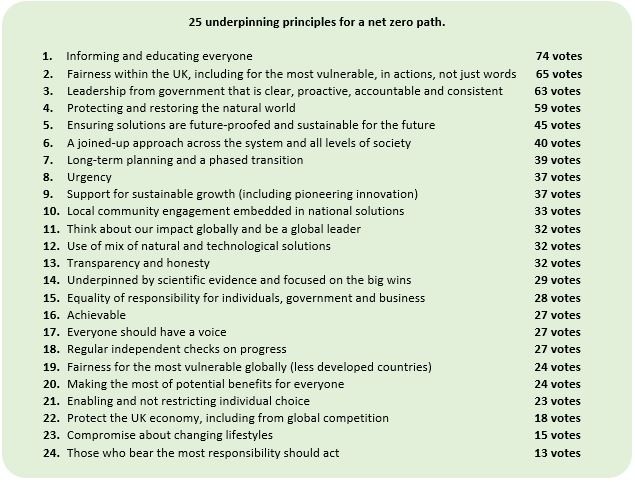
The practical recommendations are buttressed by broader themes. The assembly members identified the need for:
Improved information and education on climate change, nationwide;
Fairness – irrespective of sector, location, income and health;
Freedom and choice, for individuals and local areas;
Strong, cross-party leadership from government (which transcends ‘political point-scoring’);
Valuing the co-benefits in addressing climate change – e.g. collective wellbeing;
Restoring and enhancing the natural world.
Rather than seeking hard rules to be followed, these themes are concerned with the guiding principles which underpin good actions. They prioritise a systemic competence (instead of limited linear approaches) – i.e. they offer foundational resources for navigating highly complex topics (thus avoiding mishandling issues by trying to isolate them from the interdependent whole). The report calls on policymakers to use the Assembly’s cumulative insights as an invaluable decision-making resource.
The Assembly concluded that effectively responding to climate change demands that those in governance lay down their personal ambitions for power and short-term popularity. The jurors’reflections on expert information affirms that the challenges-in-hand extend far beyond [party] politics, and that politicians, alongside each of us, have a duty to act accordingly.
[1] One of the six members in the CCC’s ‘Costs and Benefits Advisory Group’ is a representative from Shell, which perhaps usefully reminds us that ‘impartial’, ‘neutral’ or ‘objective’ information is impossible, and no issue can be separated from wider social contexts.
Summary
The Climate Assembly UK exemplifies the worth in developing skills for exploring complex issues. We see the benefits of inclusive, respectful inquiry and how, given the supportive space and a unifying purpose, diverse opinions can advance forwards together.
A sample of the nation’s genders, ethnicities and age groups, from different areas with varying levels of education and prior climate-change knowledge, converged to have a serious chat about a very serious issue. They committed to hearing the hard facts, learning of the nation’s social-ecological challenges and failings, and stepped up to contribute to creating a new, positive path to sustainable futures.
This Assembly, and other participatory assemblies and processes like it, speak for our abilities to respond to profound challenges: to not sidestep seemingly irresolvable issues and hide behind short-term pursuits, but to gather as one Jury and take actions for a sustainable, flourishing future.
There are more things in heaven and earth, Horatio, Than are dreamt of in your philosophy.
Hamlet (1.5.167-8), Hamlet to Horatio
your philosophy ] i.e., philosophy (or learning) in general.
If I have a fond memory of my mother’s wisdom it is this quote from Shakespeare’s Hamlet she frequently used in our daily conversations. She had much more of a literary context to her take on the world than my father, whose reality was grounded in practice and his lived traumatic experience as a soldier in North Africa and Italy in WW2. I think my mother’s use of this quote might be framed by the words “dreamt of”, since it seems that Hamlet is pointing out how little even the most educated people can explain. In general terms he is talking about the limitations of human thought. And, there is no doubt that this is surfacing more into our collective consciousness, as we progress through the serious impacts of Covid -19. This is also exemplified in a new book written by a close friend and colleague Rolf Jucker, who is the Director of Silviva-an environmental education charity in Switzerland. The title of his book is Time to Live Complexity: Reflections on science, self-illusions, religion, democracy, and education for the future. The book explores this critical question: Why the crave for easy answers is at the root of our problems? It argues, persuasively that education for a viable future has never been more important than in our era of fake news, self-illusions, corporate dominance, and Fridays for future. By reflecting on several decades of theory and practice in education for sustainability his book focuses on the most important issues we need to address, if we are to succeed in creating a fair, open, just, equitable and environmentally sustainable world. We need to clarify how we can arrive at a sound understanding of reality, which belief-systems and ideologies impede this understanding and which issues need to be addressed as a matter of urgency (such as the reinvention of democracy and overpopulation). By applying the conclusions drawn on education itself, the author forces educational practitioners to reflect self-critically on their practices and increase the quality and efficacy of their interventions for a better world.
In a review of the book, I highlighted how timely it was in exploring the relationship between intelligence and rationality. Why is this so important? Because, humanity is facing an existential crisis; a pending Armageddon which threatens our very existence on planet earth because of our unsustainable lifestyles. And, yet humanity has so far failed to respond to this threat at scale and with urgency. Rolf Jucker frames this book from the standpoint of future proofing our education systems, so that current and future generations might learn and so create a more sustainable future- for all life on earth. Its premise originates from the fact that intelligence and rationality are far from perfectly correlated. Indeed, the book argues that we are beset by a huge array of false news, self-illusion, echo chambers, myths and stories which makes how our beliefs map onto the actual structure of the world(reality) increasingly difficult for us to make rational, evidence based and logical decisions. This cognitive dissonance between intelligence and rational beliefs and action is a major issue for education and learning for a sustainable future. The book explores how intelligence can be a tool for both propaganda and truth -seeking based on the ground-breaking work of Kahneman and Tversky. Most cognitive scientists now divide our thinking into two categories: system I, intuitive, automatic, fast thinking that may be prey to unconscious biases; and system 2,slow,more analytical, deliberative thinking. System 1 thinking is now considered to be the reason why people do stupid things!
It reinforces one of the real issues humanity faces around both an ancient and more recent skirmish about world views-or paradigms between the objectivists, who think that truth is a very simple matter of matching a statement against facts-something known to be true-and the other side- the subjectivists, who think that what count as facts depend on who you are, where you are from and often in what era you live in. Ideas about paradigms are very slippery-some authors ague that if you think you have it clear, then you have not got it all! We owe much to our current understanding of paradigms to Thomas Kuhn-a historian of science. He revolutionised our understanding of science by pointing out the critical distinction between Normal Science and Revolutionary Science. The first grows by gradual accretion over time and the second is more unpredictable and transformative; examples include the discoveries of Galileo, Einstein and more recently James Lovelock and the Gaia hypothesis. Kuhn’s insights gained traction in Europe where there was a tradition in favour of alternative theories of knowledge. In the USA and to some extent the UK there was an ignorance and persistent anti-paradigm empiricist(objectivist)paradigm! Why is this important ? Because the anomalies of paradigms reflect our basic belief systems and because these can significantly underpin our cognition and perceptions of reality. Kuhn’s categorisation of two types of science are more than just descriptions of baby steps and giant steps in our understanding, they are much more radical than that. They reinforce the idea that we make giant breakthroughs in our reorientation of reality but more fundamentally we alter what counts as reality. And, another great irony is that the thinking skills explored by Kahneman’s Nobel Prize winning work are still neglected in most of the well-known assessments of cognitive ability.
….in order to act as a driver for change, education itself needs to change, to become transformative, to change values and behaviours. ( Leicht, Combes, Byun, Agbedahin 2018, p29). Steve Sterling and I recently argued in a short paper for the International Association of Universities( https://iau-aiu.net/IAU-Horizons) that in our experience there is a growing and urgent need for our universities to become systemic learning organisations themselves, if they are to play a critical part in addressing the social, environmental and economic issues we currently face. We need to amplify and accelerate a shift from the old model of university as ‘ivory tower’ towards an “adaptive, innovating, and co-evolutionary engagement relationship with community and society.” This transformative model must avoid the ideological effects of the standardising global testing culture, and a rationale based solely on the needs of the economy. The traditional model must be critiqued and circumvented in favour of a higher purpose and role aligned to addressing the immense challenge and possibility of securing social and ecological wellbeing in our troubled times. As Gregory Bateson agued the logic of learning is essentially the same as the logic of evolution. The process of biological evolution is best understood as the education of a species. Adaptation is a learning process. A species learns about its environment and embodies that leaning in progressive modifications that allow it to adapt ever more successfully to its environmental niche. Those species that fail to learn, that fail to adapt, perish. Only the “educated” survive. Only those species that “learn” to adapt will procreate and prosper. If we consider the impact of this insight on our ideas about education ,then the evolutionary model of learning , as John Dewey saw long ago, is less cerebral and more pragmatic. Most approaches to education imagine it to be about packing the brain with facts and truths. For evolution, however, experiments are essential to improvement and flourishing. If experimentation, mutation, and random modification are essential to the logic of evolutionary learning ,then much of the current debate about the importance of educational standards maybe fundamentally misplaced. If educational policy pursues national standards it would appear that our nation’s students are being moulded into a single species of androids; cloned by knowledge genes that are as close to identical! If we have learned anything from evolutionary theory, it is that a rich ,healthy ecology requires diversity. As Ashby’s law of requisite variety mandates-the more varied a given gene pool, the less vulnerable a species is to disease. Any uniformity in the gene pool makes them more vulnerable to any change in their environment. As Cristina Escrigas (A Higher Calling for Higher Education | A Great Transition Initiative Essay-2016) has advocated: “ From a monoculture to an ecology of knowledges. The academic community and society as a whole need to challenge the idea that the knowledge residing in the hands of experts is the only valid kind. The supremacy of the rational-scientific paradigm is rarely called into question, but an expanded perspective provides space to consider additional ways to understand reality and to generate innovative solutions to persistent problems. Moving beyond the belief that the only criteria of truth and validity are found in science; we can see that recognizing the inherent incompleteness of knowledge is a necessary first step toward epistemological dialogue between different sources of knowledge. Even when academia incorporates knowledge from diverse sources and methods— such as community-based research, indigenous knowledge, and intercultural dialogue—it often dilutes the contributors of non-conventional perspectives rather than engaging themselves in real dialogue that seeks productive exchange. We cannot solve today’s problems with the same kind of thinking that created them. Universities need a way of connecting different types of knowledge, acknowledging their existence and giving them equal value. It is time to decolonize knowledge and adopt a knowledge-democracy framework, considering the intellectual contributions from diverse sources and worldviews. “
There is a growing interest in the idea of civic universities. It’s an idea which has a new resonance with many who believe its time for a reassessment of what a university is for(see my earlier blogs on From Green Academy to Ecological Universities and What is a University For?). I was particularly struck by what is currently happening in the Netherlands to make the connections between a university and its place. They argue that civic universities matter more than ever as “anchor institutions”. Whilst this is a poorly defined and loose term, universities are– alongside the NHS and local authorities –one of the key institutions in many places. They create wealth in a variety of ways, including through their direct spending on wages and local goods and services, and through their effects in the local economy. They play a critical role in an ageing and automated society in facilitating lifelong learning and will be crucial in helping to deal with both challenges especially in a post Corvid world. They also are increasingly involved in activity that makes life meaningful and pleasurable for local people: including education more broadly, and arts and culture. In the case of the Netherlands the national policy agenda for Higher Education and Research identifies knowledge valorisation – the creation of economic and social value from knowledge and social benefit – as a key priority. The ambition is that by 2025, research universities and universities of applied sciences will form part of localised sustainable “ecosystems” alongside the secondary education sector, secondary vocational education, research institutes, government departments, local and regional authorities, companies, hospitals, community centres and sports clubs. Is this the dawn of the “Ecological University”, I wonder
The overall performance of universities’ contribution to this agenda is monitored through a process of Performance Agreements) – now called Quality Agreements . Funding can be withheld if the plans do not meet the criteria. The separate ministries with responsibility for higher education and for city development have recently announced joint funding for “city deals” specifically to support collaboration between universities and municipalities. Most Dutch universities and their municipalities are participating in the programme. I hope our new Minister of Higher Education is following the Dutch example? The rationale for such an approach is clear. It is important for a city’s capacity for innovation that it has a strong relationship with knowledge institutes and that researchers, lecturers and students are involved in solving social problems. Not only to strengthen the problem-solving ability of the city, but also because it contributes to the training of the students of the future– who will contribute to shaping society – and gives them a better understanding of social issues. Using the society as a rich learning environment for students is therefore an important theme. The idea is that students formulate the relevant research questions together with researchers and the field (businesses, government, social institutions, citizens’ initiatives), carry out further research into urban problems and evaluate whether assumed problem-solving approaches are effective. This idea is not a new one. A similar approach initiated in an agricultural college(Hawkesbury) in New South Wales directly tackled the inadequacies of the philosophies, theories and practices of reductionist science and technology. The Hawkesbury initiative shifted their educational approach from abstract and conceptual perspectives to ways of dealing directly with reality. The central thesis of the Hawkesbury approach is that, if there are to be new ways of farming developed which are more socially and environmentally responsible, then these will be predicated by the development of ‘new ways’ of thinking, knowing and learning.
I once wrote a book review on effective executive sustainability leadership in our universities in which I declared that, in my experience, there were none who could live up to this accomplishment. I can now report that there is at least one: Michael M Crow, the President of Arizona State University. Today I listened to his 12-minute live broadcast at the UN HLPF meeting in New York (https://sustainability.asu.edu/). In those few minutes he shredded any sense that today’s universities are fit for purpose in the 21st century. He argued that universities are “inadequate” for five key reasons:
Universities are outcomes of their own design and its application. They teach and research in areas such as economics, based on models which are outmoded and sustainably untenable. In the sciences academics focus on inane arguments based on outdated notions of disciplinarity, which can be categorised as “epistemic myopia”. From a systemic perspective the whole university enterprise lacks epistemic sensibility.
Universities apply inadequate system level tools; they are basically reductionist in focus and fail to teach and research the wider more complex global and social dimensions beyond the traditional disciplinary traditions.
Universities do not reflect the cultural diversity of their local communities with respect to BAME and indigenous peoples. This narrows their sources of knowledge and its wise application.
Universities are currently “closed sequestered” places not fully and pragmatically engaged with the real world. Universities do not involve themselves with the social, environmental, and economic consequences of their work. They have no moral sensitivity because of their obsession with reductionism.
Universities are arcane, none-adaptive institutions which move at a pace which is not commensurate with the pace of change in the modern world.
Arizona State University has made some outstanding progress in developing a more systemic and transdisciplinary approach to learning with over 25 interdisciplinary programmes and many global interdisciplinary research institutes. Even so Michael Crow says that it is not enough. He believes universities need to change everything “down to their roots” and that sustainability should be a core value in everything they say and do. Michael Crow and Arizona State University seem to me to epitomise the transformative, adaptive knowledge enterprise/model that Universities need to make them fit to tackle the grand challenges of the Anthropocene.


 transformativefuturelearning.home.blog