Learning for Sustainability In Uzbekistan.
A visit to Uzbekistan is a trip to magnificent Samarkand, along the royal road to Bukhara, re-living the Silk Road. Why not visit the largest country in Asia, with a history and legacy linked to Alexander the Great, Chingkhiz Khan, and Tamerlane?
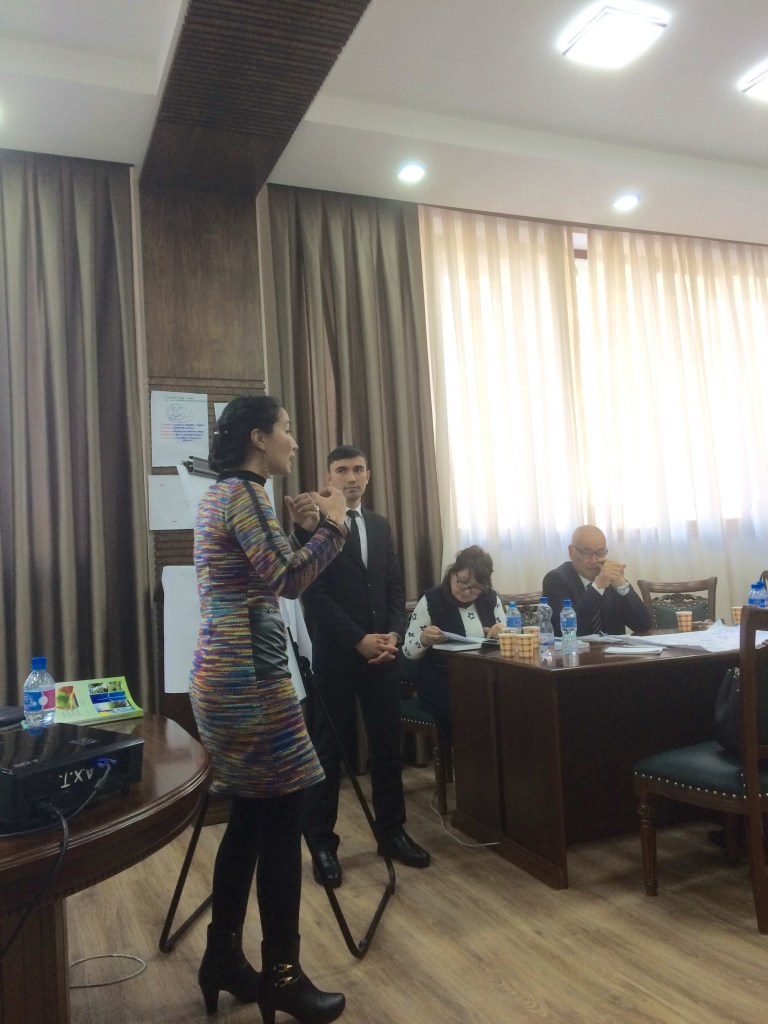
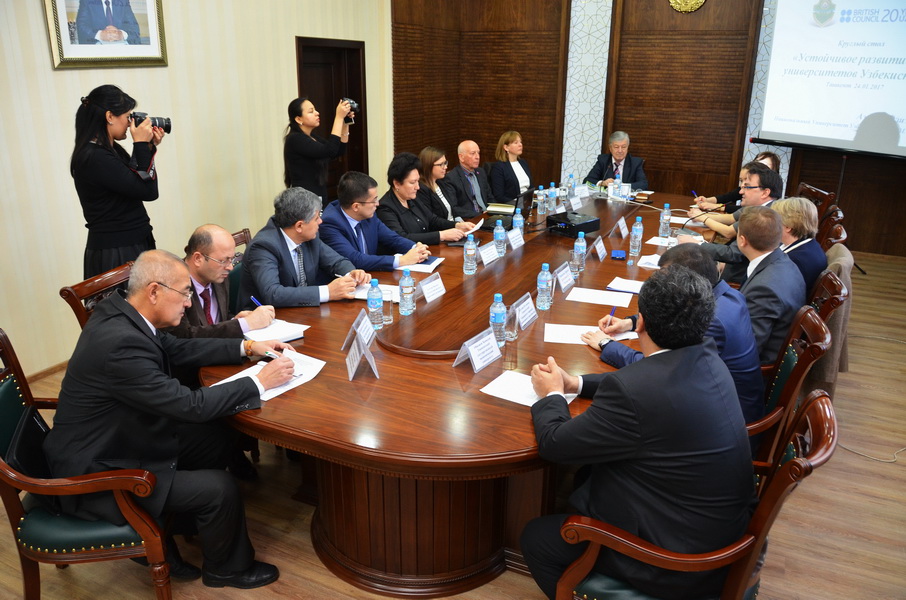
In January 2017 at the invitation of the British Council, myself and Quinn Runkle (representing the EAUC and NUS) visited the capital, Tashkent, to run a ground-breaking 3-day workshop for Rectors, senior executives, educational and environmental experts of their 58 Universities.
Why ground-breaking? Because it had never been done before and although many of the universities were teaching sound, rigorous environmental subjects, they had yet to embrace the wider concept of learning for sustainability. And anyone who has taught in the environmental sciences will know of the huge Soviet economic experiment involving the fourth largest inland sea – the Aral Sea. In the 1960s, the Soviet Union undertook a major water diversion project on the arid plains of Kazakhstan, Uzbekistan, and Turkmenistan. The region’s two major rivers, fed by snowmelt and precipitation in faraway mountains, were used to transform the desert into farms for cotton and other crops. Although irrigation made the desert bloom, it devastated the Aral Sea; one of the most unsustainable decisions ever taken – with profound social, environmental, and economic effects on this part of Asia.
The workshop design was framed by the following key principles and messages to underpin our understanding of sustainability:
- Sustainable Development is of critical importance to all us – as individuals, as organisations, as societies and as a species.
- There are hard biophysical limits to the Earth’s supportive capacity.
- Environmental problems are social problems. They begin with people and people are the victims. Social problems are inextricably linked to environmental problems; one begets the other.
- Earth is a system, itself inherently sustainable.
- A common language, or shared mental model, relating to how the earth’s sustainable processes work will help us integrate the activities of different social sectors – and indeed the different (disciplinary) parts of any organisation like a university.
We got an incredibly positive message from the participants that they enjoyed it and learned a lot from it. And, to top it off, we were interviewed at length on Uzbek Radio and TV. Our thanks to the British Council team who provided outstanding support throughout our visit! For an inside glimpse of what took place look at the clip from the TV interview: https://www.youtube.com/watch?v=cqCLjUB7JpI
Quinn Runkle (Квин Ранкл) and Steve Martin (Стефен Мартин)




 transformativefuturelearning.home.blog