PP4SD
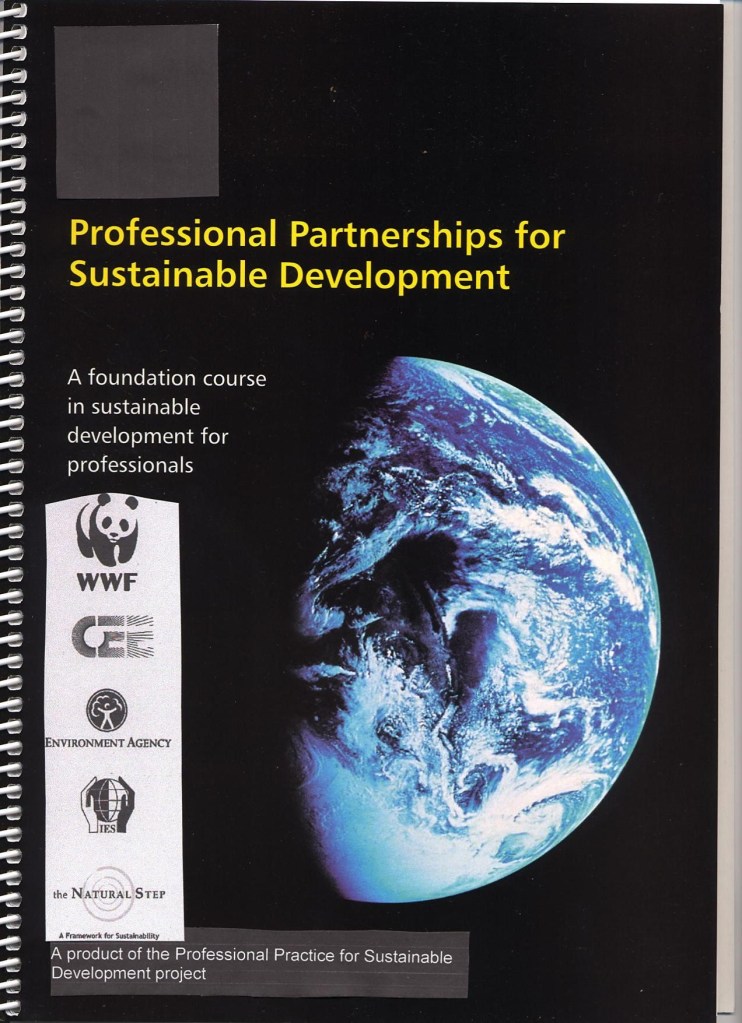
The PP4SD initiative was the main project-based activity of the Institution of the Environmental Sciences (IES) over four years. PP4SD aimed to assist professionals in integrating the principles of sustainable development into professional practice. It was led by myself, John Baines MBE and Jimmy Brannigan from the Environment Agency.
PP4SD worked with a range of professional bodies, currently 12, to support inter-professional learning in sustainable development. The learning was achieved through:
- promoting a range of inter-professional learning events.
- developing, with the professional bodies, training materials for use in professional development.
PP4SD has a project management group made up of representatives from the Institution of Environmental Sciences, the Environment Agency, The Natural Step and the Royal Society for the Protection of Birds. The Institution of Environmental Sciences provides administrative support.
The participating professional bodies currently were:
Chartered Institution of Building Services Engineers
Chartered Institution of Water and Environmental Management
Chartered Institute of Purchasing and Supply
Chartered Institute of Waste Management
Institute of Energy
Institution of Chemical Engineers
Institution of Civil Engineers
Institution of Environmental Sciences
Institution of Mechanical Engineers
Royal Institute of British Architects
Royal Institution of Chartered Surveyors
Royal Society of Chemistry
Royal Town Planning Institute
Achievements of PP4SD included:
- Preparing a one-day Foundation Course in sustainable development.
- Providing sustainable development training courses for all the participating professional bodies and a range of other organisations.
- Publishing the one-day Foundation Course as a training manual.
- Publishing a booklet presenting the ‘business’ case for sustainable development to chief executives of professional bodies.
- Publishing a booklet for the training section within a professional body, introducing the concept of sustainable development and describing some of the training tools available.
- Publishing a quarterly Newsletter.
- Organising regular inter-professional learning events. The titles are suggested by the participating professional bodies.
- Establishing a close working relationship with the Sustainability Alliance.
- Developing and presenting a training course for all the graduate intake of Barclays Bank. This is being used to extend our activities into the financial sector.
- Developing contacts and a strategy for engaging with the land-based professionals.
- Establishing a website to provide news and other information about the project. The address is http://www.ies-uk.org.uk.
The funding for the above activities came from DEFRA’s Environmental Action Fund. The professional bodies and the project management group provide support in-kind.

THE POSITIVE DEVIANT: SUSTAINABILITY LEADERSHIP in a PERVERSE WORLD by SARA PARKIN EARTHSCAN 2010
The ability to lead in building a more sustainable society requires far more than knowledge about sustainability it requires a facility for bringing about change which deals with complexity, uncertainty, multiple stakeholders, competing values, lack of end points and ambiguous terminology. In other words, leadership which can handle “wicked problems!”
The search for charismatic or “super leaders” to bring about this change has exercised the minds of many in the environmental movement, including many in the environmental professions. Some of the debate has inevitably been targeted at the paucity of political leadership – nationally and internationally, as exemplified by the limited outcomes at the world summit in Johannesburg, and more recently in Copenhagen and probably in Cancun, Mexico.
Sustainability is a big issue, probably the biggest there is. It is about whether there are birds singing in the trees, about climate change, about poverty alleviation, diminishing natural resources and about global security. It matters. Whilst it has caught the attention of some big companies such as Shell, BT, BP, Marks and Spencer, Tesco and Barclays, so far it has not caused CEOs and leaders of organisations to wake up in the middle of the night!
Perhaps the reason why sustainability only keeps a few people awake at night is that it is complex and often confusing and hence difficult to decide what to do about it. Most CEOs and other leaders are primarily trying to keep their institutions financially viable and like most of us, they have ‘a too big switch off’ mentality.
Sarah Parkin’s book is an impressive attempt to address the leadership gulf that currently exists in addressing this global issue. It describes and analyses how leadership is a complex cultural and behavioural process which influences the thoughts and behaviour of others. And it asserts that it is as much about followers and “sustainable followership” as it is about “sustainability leadership”. It is about getting people to move in the right direction, gaining their commitment and motivating them to achieve their goals because leaders need to achieve the task in hand and at the same time maintain effective relationships with individuals and groups of individuals.
The commitment of staff at all levels is vital if sustainability is to become part of the language and culture of an organisation. Strong leadership is crucial in creating opportunities for action and innovation at other levels. This process has been termed ‘vacuum management’ just as a cyclist creates a vacuum into which other racers can slip stream forward, so a leader, taking an organisation in a radical new direction creates a vacuum for others to fill with fresh ideas. Sir John Browne, now Lord Browne formerly CEO of BP, provides an example of such leadership. He took a stand against the prevailing views of the oil industry in May 1997 by publicly acknowledging the reality of climate change and withdrew BP Amoco from the Global Climate Coalition. He then wrote to the 350 senior managers in BP asking how the company might reduce its CO2 emissions. The response was overwhelmingly positive. “… no one could fail to miss the extraordinary level of support, the sheer excitement, within the company. For me, it is a matter of pride to report that BP employees do not leave their values at the door when they come to work.”
Along with Paul Murray we explored how values can help professionals understand sustainability. Paul Murray has written a very interesting paper on this which can be read here.
An important element of the PP4SD programme was how ethics can influence professional practice. You can read more here.
 transformativefuturelearning.home.blog