In 1884, John Ruskin delivered one of the first lectures to discuss climate change and make a link to industrial pollution.
Now, with the help of a group of 13- to 16-year-olds, a new exhibition Sheffield’s unrivalled Ruskin collection is taking place at the city’s Millennium Gallery.
Storm-Cloud brings together work from the Guild of St George’s Ruskin Collection and is curated by young people, and includes video work by Jake Goodall and research by the University of Sheffield to explore the legacy of Ruskin’s groundbreaking observations.
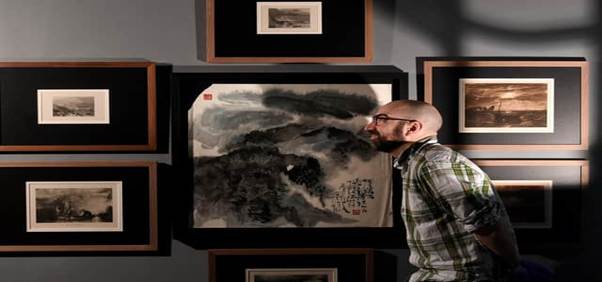
Ashley Gallant curator of the Ruskin Collection is pictured with selection of works by J.M.W Turner. Picture taken by Yorkshire Post Photographer Simon Hulme
“Ruskin delivered his pioneering lecture, The Storm-Cloud of the Nineteenth Century, after closely observing the sky over many years and concluding that the weather was changing,” explains Ruskin curator Ashley Gallant.
“He argued that a cloud wind’ was making the weather meek and mild and unpredictable and that the filth and smoke from industry from chimneys in the north were part of the cause. It was a very, very early understanding of climate change.
“The exhibition, Storm-Cloud: The Look of the Sky, takes this lecture, which was quite controversial at the time, as a starting point to present artistic and scientific observations of our sky and climate.”
Ruskin was passionate about getting people to actually look at the world around them rather than romanticise it, as was the fashion at this time.
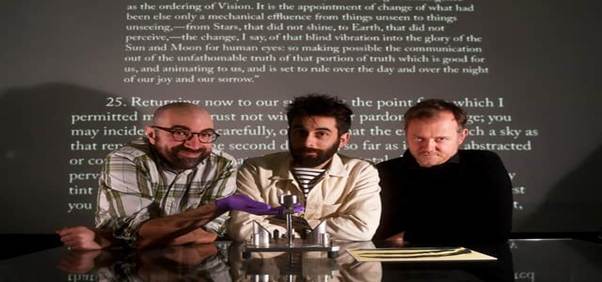
Ashley Gallant curator of the Ruskin Collection, Jake Goodall Senior Lecturer in Graphic Design at Sheffield Hallam University and Dr Tom Payne senior lecturer in performance at Sheffield Hallam University are pictured looking at a Rain Gauge and Sunshine Recorder Card Picture taken by Yorkshire Post Photographer Simon Hulme
“Among other things he was an artist fascinated by nature and his landscapes were more like photographs than edited and beautified.”
The new display is curated by The National Saturday Club, a group of 13 to 16-year-olds who meet weekly at Millennium Gallery to enjoy creative activities.
In 2001 the Ruskin Collection moved to the Millennium Gallery. Its original home was in Walkley, created by Ruskin himself 150 years ago and curated by his friend Henry Swan.
“Our education teams feedback that young people have a lot of climate change anxiety. The Collection itself is Victorian teaching collection, and we thought this was a great opportunity to work with young people on something they really cared about,” says Gallant.
“We decided we wanted to illustrate the lectures through looking at the sky and pulled out around 300 works from the collection that had images of clouds in and then we took quotes from the lecture, and the young people organised the images into the quotes which formed the basis of the sections of the exhibition.
“We then kept going back and removing and removing until we had four really tight sections. They then came back a month later and helped decide how each section was going to look.”
The result, says Gallant, means it looks different to most museum shows.
“They’ve completely changed the way we hang things, and they’ve made some really great choices and while we were working with them we could see them making the connections.
“The lecture goes from light to dark as Ruskin sees the weather changing and the show goes from light to dark in the same way.”
It also includes a new video work by Jake Goodall will be updated regularly throughout the exhibition and will go on display alongside research from the University of Sheffield, highlighting their work towards reversing climate damage by attempting to remove carbon dioxide from the atmosphere.
The display also forms part of an ongoing project which has been going for the last two years, Storm-Cloud, by Sheffield Hallam University’s Dr Tom Payne, who performs Ruskin’s lecture and invites artists to respond to the text by creating their own interpretations.
The project creates a growing collection of new art works or ‘notes and additions’, each responding directly to Ruskin and climate change.
Ruskin was a writer, art and social critic, artist and philanthropist. As an author he commanded international respect, attracting praise from figures as varied as Tolstoy, George Eliot, Proust and Gandhi and he was cited as an influence by Clement Attlee and the founders of the National Trust, among others.
He wrote on many things: art and architecture, nature and craftsmanship, literature and religion, political economy and social justice —a dizzying variety of subjects. He also worked tirelessly for a better society and his founding of the Guild of St George was one part of that endeavour.
The depth and range of his thinking, his often-fierce critique of industrial society and its impact on both people and their environment, and his passionate advocacy of a sustainable relationship between people, craft and nature, remain as pertinent today as they were in his own lifetime.
Simon Selligman of the Sheffield-based Guild of St George was created by Ruskin in the 1870s as a small educational arts and wellbeing charity.
“The Guild was very much inspired by the medieval Guilds across Europe of like-minded people coming together to make the world a happier healthier place.
“Ruskin came from a wealthy background so he never had to work for a living but rather than buy art for himself to fill a grand house his passion becomes how can art and access to nature and wellbeing help ordinary people who he felt were in danger of becoming machines due to the industrial revolution,” says Selligman.
“He had profound anxiety that this was not good for human beings and that human beings need access to beauty in nature and art inspired by nature.
“A lot of things in the Collection, that he created for the public good, are from him sending artists off across Europe, particularly to Venice which he loved, to draw or paint beautiful things and bring them back to Sheffield for working people to have direct access to them.”
Selligman says Ruskin’s plan had been for a number of similar museums and they would all be called St George’s Museums.
“He saw St George as symbolic figure, being brave, confronting the ills of society and Ruskin saw the dragon as industrialism.”
But in the end Walkley became the first and only museum.
“People had to walk through nature to get to the museum high up where the air was cleaner, to what was in essence a cottage he bought and extended which housed these extraordinary things form all over Europe which he hoped would inspire.
“He really admired the craftsmanship of the tool makers of Sheffield and he wanted them to see that they were artists too.”
And what does he think Ruskin would have made of today’s exhibition of his collection in the Millennium Gallery?
“I think he would have been very inspired by what Ash is doing.
“What the museum is now doing is say look we can break open this collection and get it into the dialogue of the issues of today and I hope Ruskin would have loved that. He was engaged with the issues of the day.
“I hope he would have been excited by it but one of the things about Ruskin was that you could never predict him.”
The Ruskin Collection: Storm-Cloud – The Look of the Sky is on at the Millennium Gallery, Sheffield until Sunday November 29
 transformativefuturelearning.home.blog